Residencies vary more than any other kind of open call: some pay you, some charge you, some give you a studio and a kiln, others a desk and a bed. Some offer time and space with no conditions, others expect a tangible outcome such as an artwork, an exhibition or a workshop, as the TransArtists overview of residency types puts it. A short checklist helps you compare them and prepare the application without surprises.
Before you apply: what is actually offered
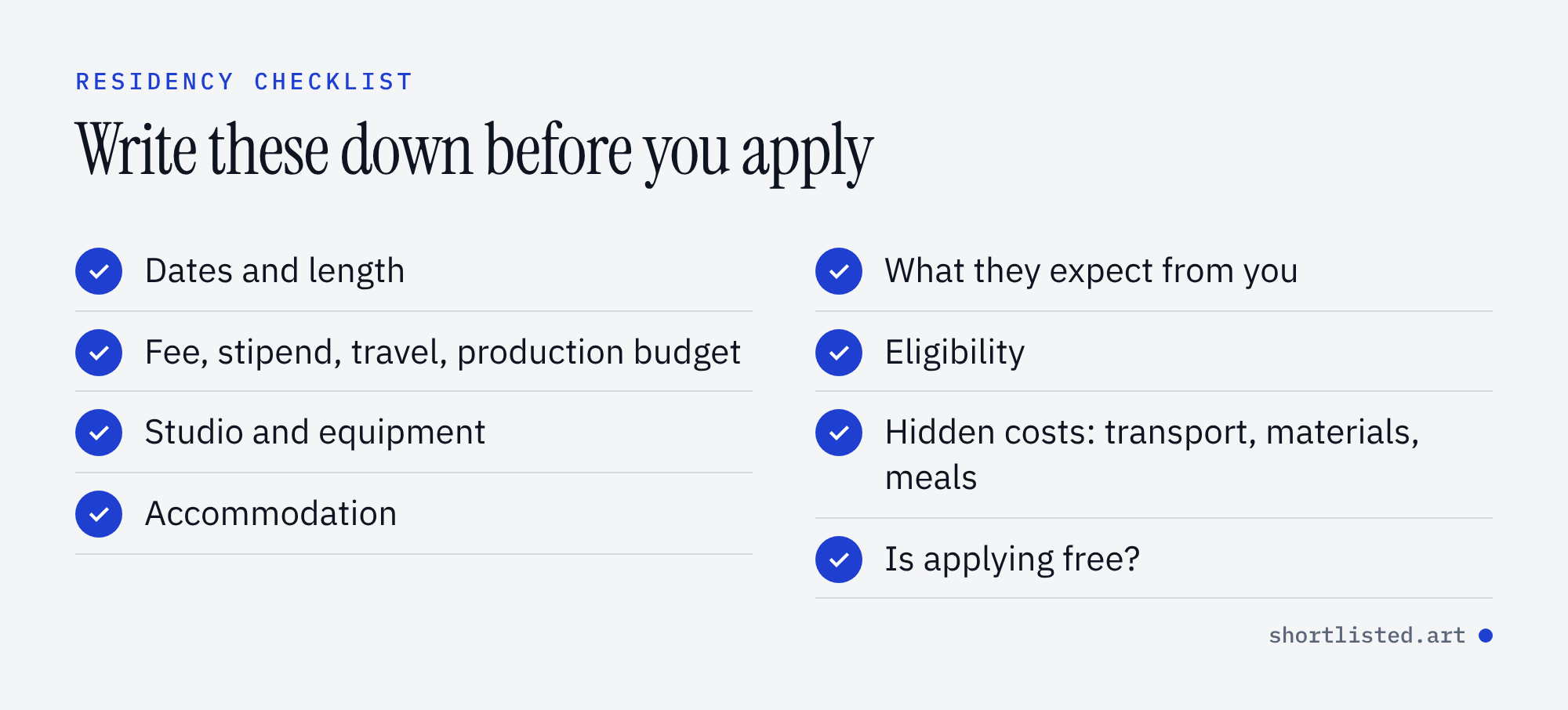
Read the call for these points and write them down:
- Dates and length: fixed dates or flexible? Can you be away that long?
- Money: is there a fee, a stipend, a production budget, travel? "Fully funded" should mean that accommodation and studio are free and some living or travel costs are covered. Check exactly which.
- Studio and equipment: private or shared studio, size, access hours, specific equipment such as kilns, presses, darkroom or workshop tools.
- Accommodation: private room or shared, whether a partner or child can come.
- Expectations: an exhibition, an open studio, a talk, a workshop, a donated work.
- Eligibility: age, nationality or residence, career stage, language. Our guide to eligibility rules explains how to read them.
- Hidden costs: the RISD Career Center warns that even funded residencies can leave you paying for transport, materials or meals.
- The application itself: TransArtists suggests checking whether applying costs money and whether signing the forms already commits you to obligations.
The fully funded, with a kiln and no application fee pages in our catalogue filter for three of these conditions.
Plan ahead
TransArtists notes that participation in a residency is usually planned about six months in advance, and sometimes years ahead (checklist). If residencies matter to your practice, put them in your yearly plan rather than applying when a deadline happens to appear. Our guide to planning a year of applications shows how to keep a simple tracker.
What the application usually asks for
- A project proposal or a motivation statement about what you will do during the residency. See how to write a project proposal.
- An artist statement.
- A CV, sometimes a short bio.
- Images of recent work, with an image list (title, year, materials, size).
- A budget, if production money is offered.
- Sometimes a letter of reference or a short video.
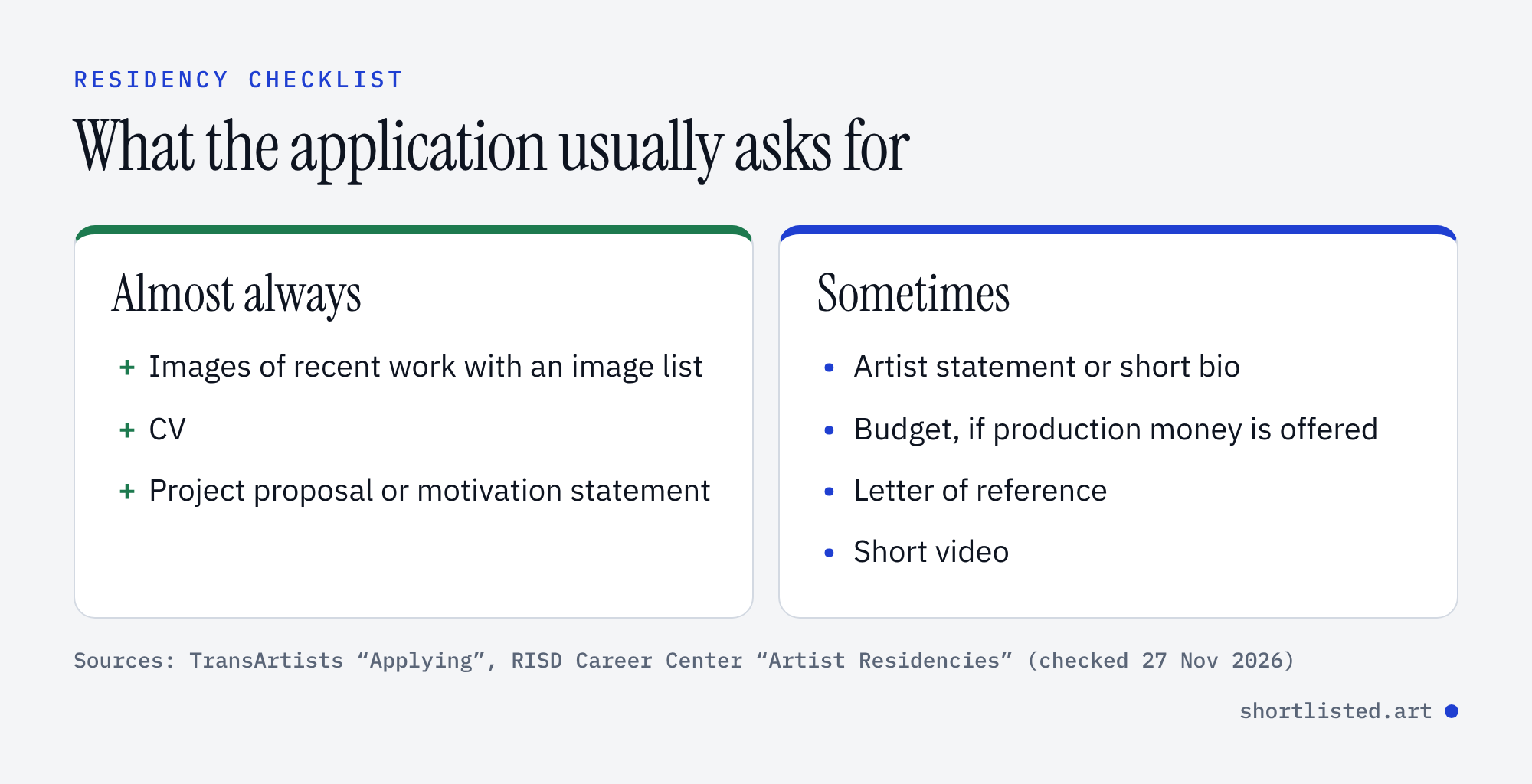
Both TransArtists and the RISD Career Center list documentation of your work, a CV and a statement or proposal as the core materials. Prepare these in advance and keep them up to date; most of the work is reusable.
Write a proposal for this place
Residency juries want to know why you need to be there and not anywhere else. Mention what in the place matters to your project: the landscape, a material, a local craft, an archive, the equipment. Be concrete about what you will make or research, how it builds on your practice, and what fits in the time; a rough production timeline helps.
Questions worth asking the organiser
If something is unclear, write to the organiser before applying. Typical questions: Is the studio private? Is there a kiln and who fires it? Are materials included? Is there a fee hidden in the "participation contribution"? Can work be shipped home at the end? Can the dates change? TransArtists also advises confirming the deadline directly with the person in charge. A clear, polite answer is also a good sign about the organisation.
Past residents are a good source too. The RISD Career Center suggests looking at past participants listed on the residency's website and asking one of them for a short conversation.
Red flags
Be careful when the fee is high and the offer is vague, when there is no information about past residents, or when the only contact is a form. See our guide on application fees and red flags.
Shortlisted reads each residency call into the same fields (dates, funding, fee, facilities, eligibility, what they ask for), checks the rules against your profile and drafts the proposal around the work that fits best. See what a finished package looks like in the sample application pack.
Organisations named are not affiliated with Shortlisted. Check every rule and deadline on the organiser's site before applying.
ResidenciesFully funded open callsResidencies with a kilnOpen calls with no fee/guides/planning a year of applications