Your CV is not a biography. When a jury reads it during selection, they are asking one question: does this artist have the experience and commitment to deliver what we are offering? That means your CV should be a quick, structured scan of your track record, not a story or a sales pitch.
Most open calls ask for a one- or two-page CV. If you are early in your career and your CV does not fill a page, that is normal and not a reason to pad it out. A short, honest document is always better than one stuffed with irrelevant detail.
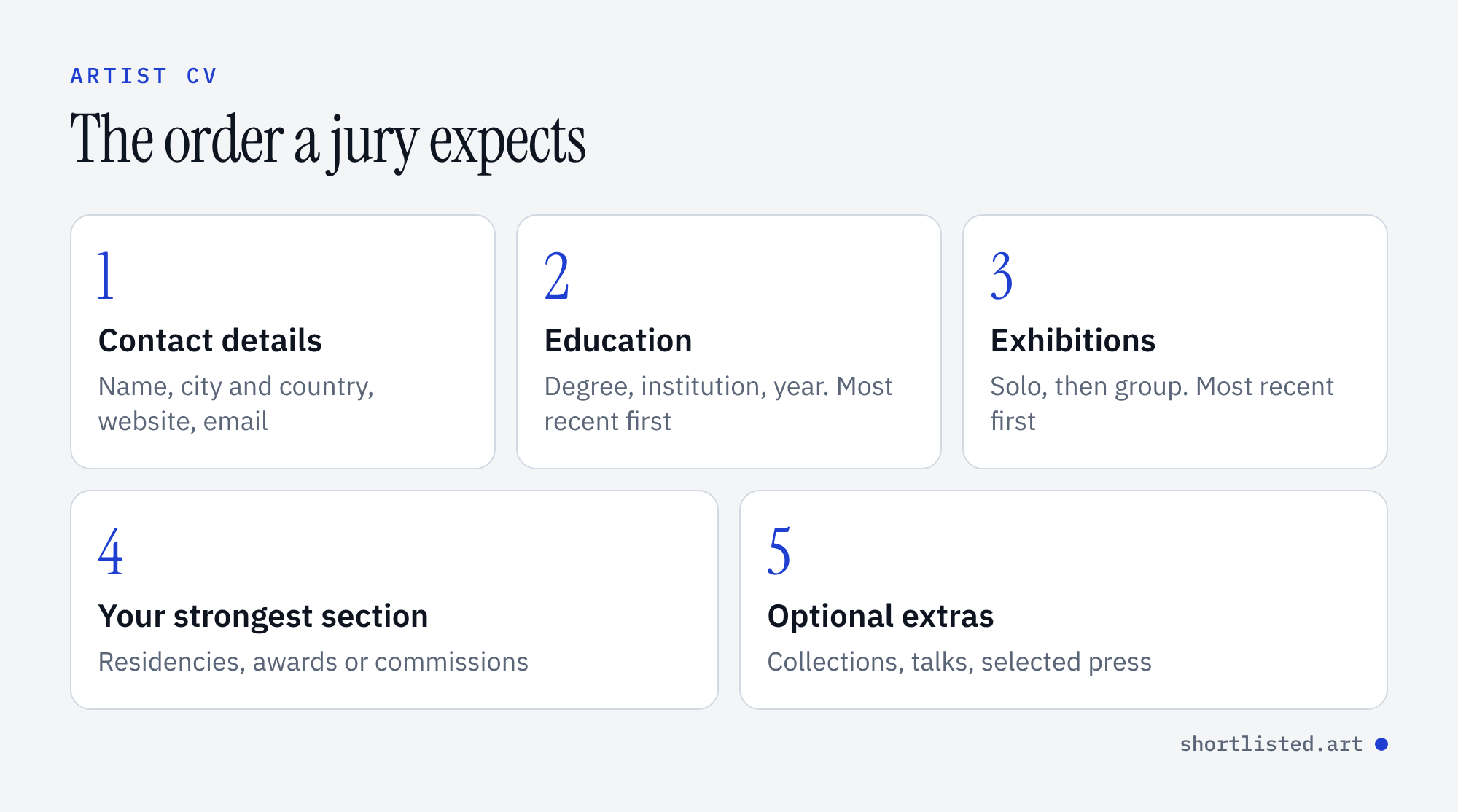
Start with contact details and education
At the top, put your name, your location (city and country is enough), your website, and an email address. Do not include your full postal address, date of birth or a photograph unless the call specifically asks for them.
Underneath, list your education in reverse chronological order: degree title, institution, location, and year of graduation. If you studied art at degree level, include it. If your degree is unrelated to your practice and you have professional exhibitions or residencies, you can leave education out. Do not list secondary school.
Exhibitions: solo, then group, most recent first
This is the section juries spend the most time on. Split it into two subsections: Solo exhibitions and Group exhibitions. Within each, list the most recent first.
For each entry, use this order: year, exhibition title (in italics or plain text, be consistent), venue name, city, country (if outside your own). You do not need to add the month or the street address. If the venue is well known, the name is enough. If it is a project space or a less formal setting, make that clear by naming it accurately.
If you have only one or two exhibitions, do not split them into solo and group. Just call the section Exhibitions and list them together.
What to do when you have few exhibitions
If you are emerging and your exhibition list is short, do not invent or inflate. Instead, include other sections that show your practice is active:
- Residencies and workshops: where you have worked, with dates and locations.
- Awards and grants: name, awarding body, year. Include longlists and shortlists if the prize is recognised.
- Screenings or performances: especially relevant for time-based or digital work.
- Collections: if your work has been acquired, name the collection (public or private) and the year.
- Talks, panels or publications: if you have presented your work in public or been featured in a catalogue, journal or serious online publication.
Choose two or three of these that apply to you. Do not add a section with nothing in it.
What to leave out
Do not include:
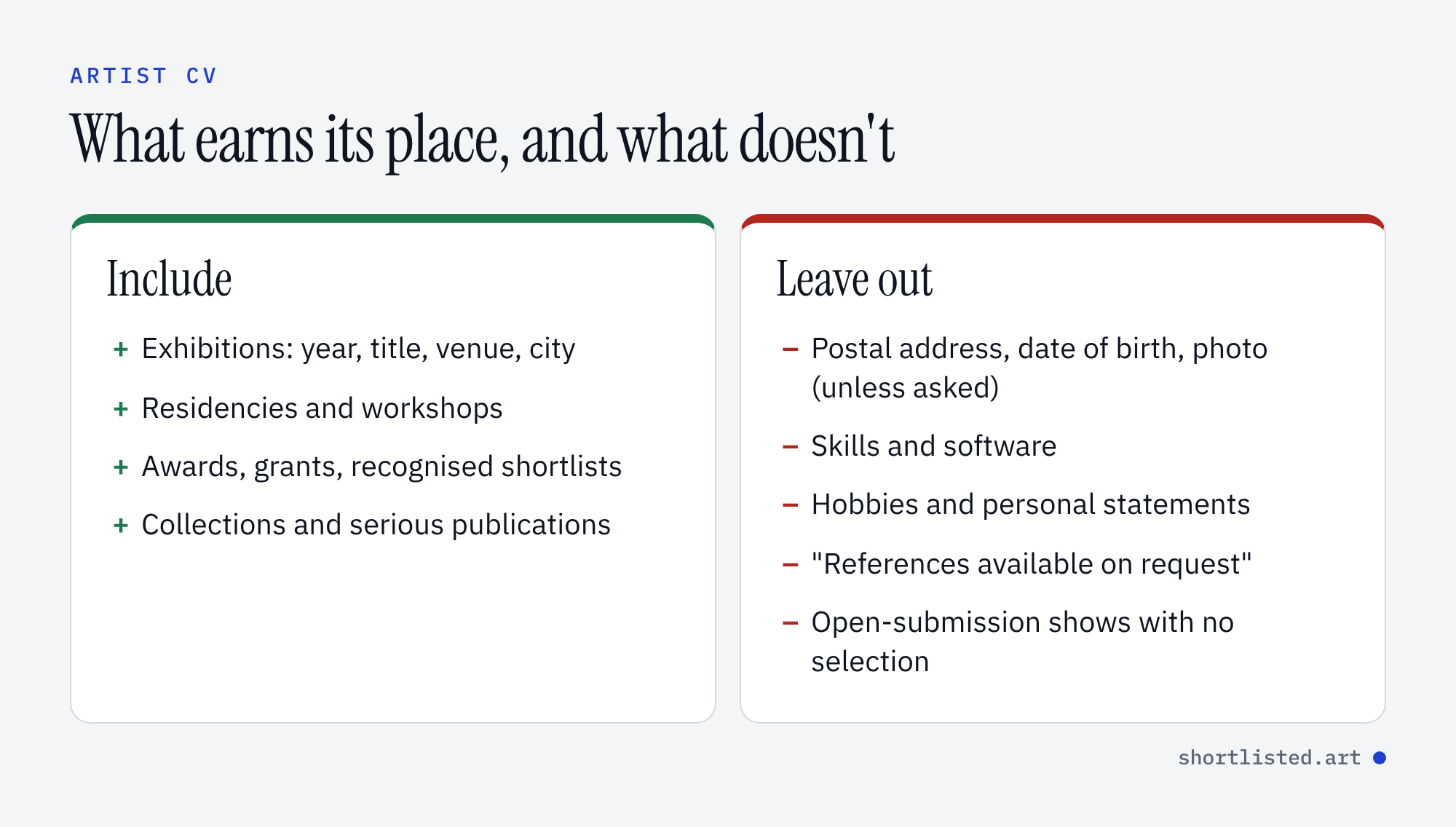
- Press or reviews unless the publication is significant. A mention in a major newspaper or art magazine can go under Selected press, but blog posts and small notices add no weight.
- Skills or software: your CV is not a job application. The work you submit shows what you can do.
- Hobbies, interests or personal statements: the CV is a record, not a cover letter.
- References or the phrase "references available on request": this is assumed.
- Group exhibitions where you were one of dozens of artists in an open submission show with no selection: if every applicant was included, it does not demonstrate selection by a jury or curator. Be honest with yourself about which group shows strengthen your case.
Order and optional sections
After exhibitions, the order of remaining sections depends on what is strongest in your practice. If you have several residencies, put that next. If you have won a significant prize, put awards high up.
Some artists include a short Selected bibliography or Publications section if their work has been written about in catalogues or journals. Others add Commissions if they have made work to order for public or private clients, particularly relevant for public art or commissions.
If you teach or have other professional roles in the arts (curator, technician, coordinator), you can add a Professional experience section, but keep it brief. Only include roles that reinforce your standing as a practising artist.
Formatting: simple, readable, consistent
Use a standard typeface, black text, white background. No colours, borders, logos or headers on every page. Your name and page number in the footer are enough if the CV runs to two pages.
Use bold sparingly: for section headings and perhaps for exhibition or venue names, but not both. Italics can be used for exhibition titles. Keep the same format for every entry in a section.
Align text to the left. Use single line spacing within entries and a little extra space between them. If your CV is half a page, do not stretch the spacing to fill a page. Leave it as it is.
Tailor lightly, but keep one master version
You do not need to rewrite your CV for every application, but you can reorder sections when it makes sense. If you are applying to a residency, move residencies up. For a prize, foreground awards. For an exhibition call, keep exhibitions at the top.
Do not remove accurate information to make the CV shorter unless it is truly irrelevant. If a jury wants one page and you have two strong pages, cut the oldest or least relevant entries, not entire sections.
Shortlisted matches open calls to your portfolio, rules out the ones you cannot enter, and drafts a CV and other application materials tailored to each call. You edit and send the final version.