Most artists apply to open calls in bursts—when a friend shares a link, when a deadline looms, or when studio income dips. A better approach is to set a realistic number for the year, learn when the calls you care about come round, and keep a tracker that shows you what works. Planning does not mean applying to everything; it means focusing your effort where it counts.
Decide how many applications you can sustain
There is no universal number. The right amount depends on your practice, your time, and whether you are paying fees. Start from your calendar rather than from ambition: estimate how many hours one application takes you, look at how many of those blocks you can realistically free up in a year, and set the number from that. Spread it across residencies, exhibitions, grants and prizes.
If you are starting out or have limited hours, a small number of thoughtful applications is enough to learn what juries respond to and to build a habit. If you have more time, work that travels easily, or draft materials you can adapt quickly, a higher number becomes manageable.
What drains time is not the number itself but starting from scratch each time: rewriting statements, resizing images, reconstructing CVs. If you prepare core materials once and adapt them call by call, each application takes far less effort. Set a number at the start of the year and adjust after three months based on how long each application actually took.
Learn the rhythm of the calls you care about
Open calls do not appear evenly across the calendar, and the rhythm differs by country, medium and type of call. Many prizes, residencies and festivals run every year, often with a similar deadline, so last year's dates are a useful guide to when the next call will open.
Make a short list of the calls you most want to enter and note last year's deadline for each. That list becomes your calendar: it shows where the busy weeks are and which months are quiet. Use the quiet months to update your portfolio, refresh your CV, or draft a new project proposal without deadline pressure. Residencies in particular are often planned months ahead; TransArtists notes that a residency stay is usually planned about six months in advance, sometimes longer.
Browse calls closing soon every few weeks to see what is coming up, and check biennales separately if they are a priority. After one year of keeping notes, you will know when to block time in your calendar.
Keep a simple tracker
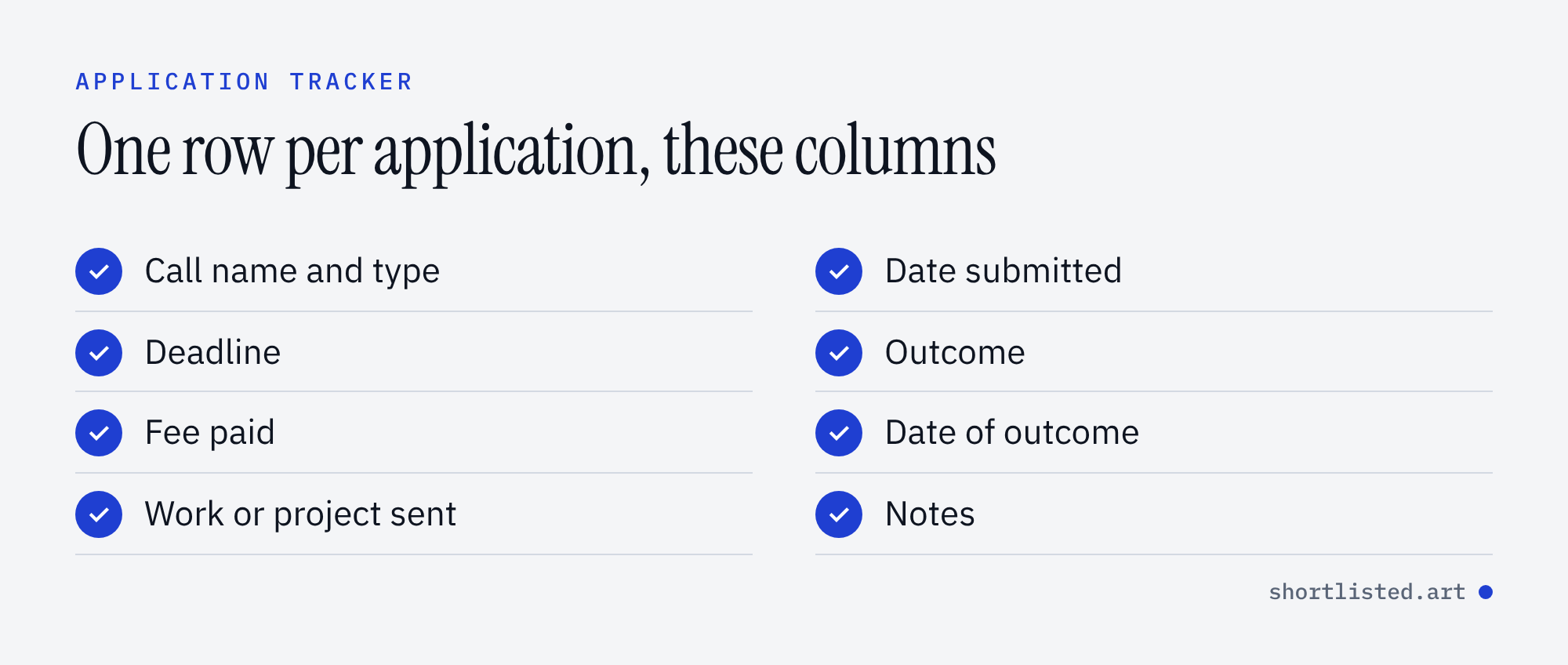
A tracker is not busywork; it is the only way to see patterns in what you apply to, what gets answered, and where your time goes. You do not need software. A spreadsheet with one row per application and these columns is enough:
- Call name and type (residency, prize, exhibition, grant)
- Deadline
- Fee paid (if any)
- Work or project sent
- Date submitted
- Outcome (selected, longlisted, rejected, no reply)
- Date of outcome
- Notes (what felt strong, what you would change)
Fill it in as you go. After six months, sort by outcome and look for signals. Do no-fee calls reply as often as paid ones? Does one body of work get shortlisted more than another? Do you spend more time on applications that go nowhere? The tracker shows you where to focus next year.
It also gives you a record for funding applications, CVs and conversations with galleries: you can say precisely what you applied to, when, and what happened.
Balance reach and realism
Not every application is a long shot, and not every one is a safe bet. A sustainable year mixes both. If you apply only to prestigious prizes that attract very large numbers of entries, the silence becomes discouraging. If you apply only to calls that feel easy, you may not stretch your practice or your audience.
One way to balance it: for every high-reach application—an international prize, a major commission, a biennale—add a few that match your career stage, medium and location more closely. Look at past recipients or exhibitors. If none of them look like you in terms of practice, geography or experience, the call may not be aligned yet. Before you start, read the eligibility rules carefully; a call you cannot enter is time lost.
Region matters too. If you live and work in one country, a mix of local, national and international calls often works better than international alone. Local and national calls can mean more dialogue with organisers and lower costs to attend.
Prepare materials between deadlines, not during them
The bottleneck in most application cycles is not finding calls but having materials ready. If your CV is out of date, your images are not labelled consistently, or you have no draft artist statement, every deadline becomes a crisis.
Use the quiet months to build a small library: a one-page CV and a two-page version; a short bio and a longer one; a set of images of your strongest work, cropped and labelled; a paragraph describing your practice that you can adapt. Write a rough project proposal for an idea you want to develop, even if no call exists yet. When a good opportunity appears, you will adapt existing material rather than generate it under pressure.
This preparation is not speculative. It is how you make a realistic application cycle possible.
Review and adjust every quarter
At the end of every three months, open your tracker and ask: did I apply to the number I planned? Did I spread applications across types of calls, or did I chase only one kind? Are outcomes improving as my materials improve, or is something not working?
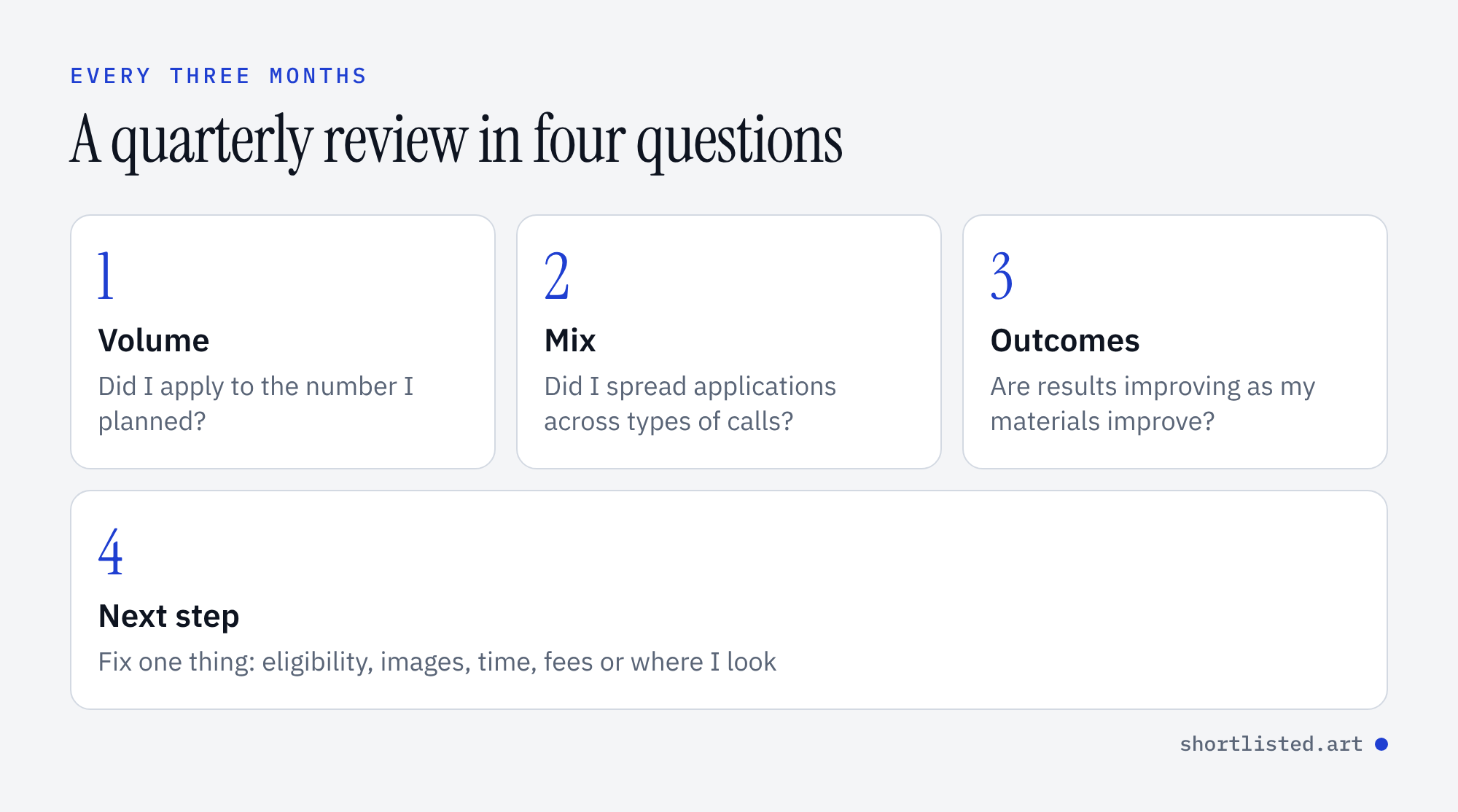
If you are applying but hearing nothing, the issue may not be the work—it may be eligibility mismatches, weak image quality, or calls that do not align with your practice. If you are not applying enough, the issue may be time, fees, or not knowing where to look. The tracker tells you which problem to solve.
A year of applications is not a year of hoping. It is a year of learning what your work needs, where it belongs, and how to put it in front of the people who can say yes.
Shortlisted matches open calls against each work in your portfolio, rules out calls you cannot enter, and drafts application materials—proposal, statement, CV, budget—so you spend time editing and deciding rather than starting from nothing each time. Try it here, or start with the residency application checklist.
Organisations named are not affiliated with Shortlisted. Check every rule and deadline on the organiser's site before applying.
Closing in the next two weeksResidenciesOpen calls with no fee/guides/open call fees and red flags